Manipularea creierului și neurotehnologia (II)
III. Ce este neurotehnologia?
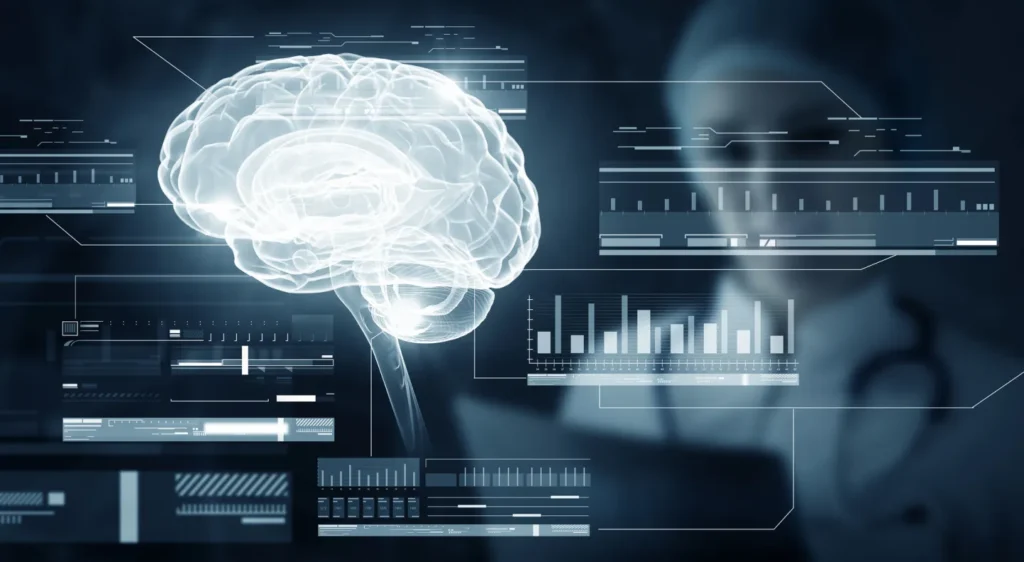
Neurotehnologia reprezintă domeniul care dezvoltă metode și dispozitive capabile să interacționeze cu sistemul nervos uman. Aceste tehnologii permit monitorizarea activității cerebrale, stimularea neuronilor și interpretarea semnalelor generate de creier.
Neurotehnologia se bazează pe colaborarea dintre mai multe discipline: neurologie, neuroștiințe, informatică, inginerie biomedicală, inteligență artificială și robotică.
Aceste cercetari au avut inițial scop medical cum ar fi:
- tratarea bolilor neurologice;
- recuperarea funcțiilor pierdute;
- îmbunătățirea performanțelor cognitive;
- comunicarea directă dintre creier și dispozitivele digitale.
Există două categorii principale de neurotehnologii:
- Neurotehnologii invazive – presupun implantarea unor dispozitive în creier.
- Neurotehnologii non-invazive – utilizează senzori externi pentru monitorizarea activității cerebrale.
Tehnologiile moderne permit vizualizarea activității cerebrale în timp real, fapt ce ajută la diagnosticarea bolilor neurologice și la studierea funcționării creierului.
Astfel:
- Stimularea cerebrală profundă este utilizată pentru tratarea bolii Parkinson, tremorului esențial, depresiei severe și epilepsiei.
- Neuroprotezele sunt dispozitive care înlocuiesc anumite funcții nervoase afectate, cum ar fi implanturile cohleare pentru auz, protezele controlate prin semnale neuronale și dispozitivele pentru recuperarea mișcării.
- Interfețele creier–calculator reprezintă una dintre cele mai spectaculoase dezvoltări ale neurotehnologiei. Aceste sisteme permit comunicarea directă dintre creier și un calculator sau un alt dispozitiv electronic. Sunt utilizate pentru controlul protezelor robotice, comunicarea persoanelor paralizate, controlul computerelor sau recuperarea funcțiilor motorii.
- Inteligența artificială joacă un rol esențial în dezvoltarea neurotehnologiei moderne. Algoritmii AI sunt utilizați pentru analiza activității neuronale, interpretarea semnalelor cerebrale, detectarea bolilor neurologice și predicția comportamentului.
Neurotehnologia este considerată una dintre cele mai revoluționare direcții ale medicinei moderne. Nanotehnologiile au deschis posibilitatea influențării activității neuronale și a comunicării directe cu creierul, cu perspectiva de a modifica comportamentul, emoțiile și chiar procesele cognitive ale oamenilor. Astfel de tehnologii ridică numeroase întrebări etice și sociale.
IV. Probleme bioetice
Dezvoltarea rapidă a neurotehnologiei a generat unele dintre cele mai complexe dezbateri bioetice contemporane. Posibilitatea de a monitoriza, a interpreta și a influența activitatea cerebrală ridică întrebări fundamentale privind libertatea umană, identitatea personală și limitele intervenției tehnologice asupra minții. Numeroși specialiști avertizează că dezvoltarea necontrolată a neurotehnologiei poate afecta drepturile fundamentale ale omului.
Neurotehnologia poate produce efecte sociale importante.
De exemplu, accesul inegal la tehnologii de îmbunătățire cognitivă poate genera noi forme de inegalitate socială.
Există riscul utilizării tehnologiei pentru supraveghere digitală, manipulare politică, control militar și influențarea comportamentului colectiv, deoarece cercetările au demonstrat că stimularea anumitor regiuni ale creierului poate modifica starea emoțională, comportamentul, memoria și capacitatea de luare a deciziilor.
Acest lucru ridică probleme serioase privind libertatea mentală și autonomia individului.
În viitor, poate și în prezent, neurotehnologia ar putea fi utilizată nu doar în scop medical, ci și în cel militar, comercial sau politic. Posibilitatea utilizării tehnologiei pentru manipularea maselor reprezintă una dintre cele mai mari temeri bioetice contemporane.
– Va urma –
Bibliografie
Alpert, Sheryl. “Brain-Computer Interface Devices: Risks and Canadian Regulations.” Accountability in Research 15, no. 2 (2008): 63–86.
Anumanchipalli, Gopala K., Josh Chartier, și Edward F. Chang. “Speech Synthesis from Neural Decoding of Spoken Sentences.” Nature 568 (2019): 493–498.
Babayan, Eduard A. Psychotropic Drugs in the Soviet Union. Moscow: Meditsina Press, 1973.
Becker, Kira, John R. Shook, Martina Darragh, și James Giordano. “A Four-Part Working Bibliography of Neuroethics: Part 1 – Overview and Reviews.” Philosophy, Ethics, and Humanities in Medicine 11, no. 9 (2016).
Bekhterev, Vladimir. General Principles of Human Reflexology. Petrograd: Gosizdat, 1917.
Biserica Catolică. Catehismul Bisericii Catolice. Vatican City: Libreria Editrice Vaticana, 1997.
Biserica Ortodoxă Română. Bioetica și demnitatea persoanei umane în creștinismul ortodox. București: Basilica, 2019.
Bloch, Sidney, și Peter Reddaway. Soviet Psychiatric Abuse: The Shadow over World Psychiatry. Boulder, CO: Westview Press, 1984.
Broca, Paul. “Remarques sur le siège de la faculté du langage articulé.” Bulletins de la Société Anatomique de Paris 6 (1861): 330–357.
Burwell, Sasha, Matthew Sample, și Eric Racine. “Ethical Aspects of Brain Computer Interfaces: A Scoping Review.” BMC Medical Ethics 18, no. 60 (2017).
Cabrera, Laura Y., și Douglas J. Weber. “Rethinking the Ethical Priorities for Brain–Computer Interfaces.” Nature Electronics 6 (2023): 10–12.
Charcot, Jean-Martin. Lectures on the Diseases of the Nervous System. London: New Sydenham Society, 1889.
Churchland, Patricia S. Braintrust: What Neuroscience Tells Us About Morality. Princeton: Princeton University Press, 2011.
Clausen, Jens. “Conceptual and Ethical Issues with Brain-Hardware Interfaces.” Current Opinion in Psychiatry 24, no. 6 (2011): 495–501.
Clausen, Jens. “Man, Machine and in Between.” Nature 457 (2009): 1080–1081.
Cole-Turner, Ronald, ed. Transhumanism and Transcendence: Christian Hope in an Age of Technological Enhancement. Washington, DC: Georgetown University Press, 2011.
Delgado, José M. R. Physical Control of the Mind: Toward a Psychocivilized Society. New York: Harper & Row, 1969.
Demetriades, Andreas K., et al. “Brain-Machine Interface: The Challenge of Neuroethics.” The Surgeon 8, no. 5 (2010): 267–269.
Diefenbach, Gretchen J., et al. “Lobotomy and the History of Psychosurgery.” Psychiatric Clinics of North America 22, no. 2 (1999): 367–382.
Engelhardt, H. Tristram Jr. The Foundations of Christian Bioethics. Lisse: Swets & Zeitlinger, 2000.
Farah, Martha J. Neuroethics: An Introduction with Readings. Cambridge, MA: MIT Press, 2010.
Floridi, Luciano. The Ethics of Artificial Intelligence. Oxford: Oxford University Press, 2023.
Foucault, Michel. Madness and Civilization: A History of Insanity in the Age of Reason. New York: Vintage Books, 1988.
Freud, Sigmund. The Interpretation of Dreams. London: Macmillan, 1913.
Galen. On the Usefulness of the Parts of the Body. Translated by Margaret Tallmadge May. Ithaca, NY: Cornell University Press, 1968.
Giordano, James. Neurotechnology: Premises, Potential and Problems. Boca Raton: CRC Press, 2012.
Gilbert, Frederic, et al. “The Ethics of Brain–Computer Interfaces.” Nature Electronics 2 (2019): 159–161.
Haselager, Pim, et al. “Note on Ethical Aspects of BCI.” Neural Networks 22, no. 9 (2009): 1352–1357.
Haslam, Nick. “Psychology in the Bathroom: A Review of the History of Lobotomy.” History of Psychiatry 16, no. 2 (2005): 219–223.
Hipocrate. On the Sacred Disease. În Hippocratic Writings, translated by G. E. R. Lloyd. London: Penguin Classics, 1978.
Human Brain Project. Annual Report. Brussels: European Commission, 2021.
Ienca, Marcello, și Roberto Andorno. “Towards New Human Rights in the Age of Neuroscience and Neurotechnology.” Life Sciences, Society and Policy 13, no. 5 (2017).
Jones, James H. Bad Blood: The Tuskegee Syphilis Experiment. New York: Free Press, 1993.
Klein, Eran, și Judy Illes. “Ethics in Neuroengineering.” Handbook of Clinical Neurology 118 (2013): 251–266.
Klein, Eran, et al. “Brain-Computer Interface-Based Control of Closed-Loop Brain Stimulation.” Brain-Computer Interfaces 3 (2016): 140–148.
Levy, Neil. Neuroethics. Cambridge: Cambridge University Press, 2007.
Lifton, Robert Jay. Thought Reform and the Psychology of Totalism: A Study of “Brainwashing” in China. New York: Norton, 1961.
Marks, John. The Search for the Manchurian Candidate: The CIA and Mind Control. New York: Times Books, 1979.
Moniz, António Egas. Tentatives opératoires dans le traitement de certaines psychoses. Paris: Masson, 1936.
Morley, Jessica, et al. “Regulating Next-Generation Implantable Brain-Computer Interfaces.” arXiv (2025).
Nicolelis, Miguel. Beyond Boundaries: The New Neuroscience of Connecting Brains with Machines. New York: Times Books, 2011.
Nutton, Vivian. Ancient Medicine. London: Routledge, 2004.
Orwell, George. 1984. London: Secker & Warburg, 1949.
Papa Francisc. Fratelli Tutti: On Fraternity and Social Friendship. Vatican City: Libreria Editrice Vaticana, 2020.
Pavlov, Ivan. Conditioned Reflexes: An Investigation of the Physiological Activity of the Cerebral Cortex. Oxford: Oxford University Press, 1927.
Peters, Ted. Playing God? Genetic Determinism and Human Freedom. New York: Routledge, 2002.
Peters, Ted, Robert John Russell, și Michael Welker, eds. Neuroscience and the Person: Scientific Perspectives on Divine Action. Vatican Observatory Publications, 1999.
Pontifical Academy for Life. Rome Call for AI Ethics. Vatican City, 2020.
Pontifical Council for Culture. The Human Person in the Age of Neurosciences. Vatican City: Vatican Press, 2013.
Plato. Timaeus. Translated by Donald J. Zeyl. Indianapolis: Hackett Publishing, 2000.
Prokopenko, Anatoly S. Bezumnaya Psikhiatriya: Sekretnye Materialy o Primenenii v SSSR Psikhiatrii v Karatelnykh Tseliakh. Moscow: Sovershenno Sekretno, 1997.
Racine, Eric. Pragmatic Neuroethics. Cambridge, MA: MIT Press, 2010.
Reiner, Peter B. “Neuroethics and the Problem of Enhancement.” Current Opinion in Psychiatry 17, no. 2 (2004): 97–100.
Rose, Nikolas, și Joelle Abi-Rached. Neuro: The New Brain Sciences and the Management of the Mind. Princeton: Princeton University Press, 2013.
Rubenstein, Joshua, și Alexander Gribanov, eds. The KGB File of Andrei Sakharov. New Haven: Yale University Press, 2005.
Saha, Simanto, et al. “Progress in Brain Computer Interfaces: Challenges and Trends.” arXiv (2019).
Sargant, William. Battle for the Mind: A Physiology of Conversion and Brain-Washing. London: Heinemann, 1957.
Schweiker, William. Dust That Breathes: Christian Faith and the New Humanisms. Oxford: Wiley-Blackwell, 2010.
Shorter, Edward. A History of Psychiatry. New York: John Wiley & Sons, 1997.
Shoaran, Mahsa, et al. “Intelligent and Miniaturized Neural Interfaces.” arXiv (2024).
Snezhnevsky, Andrei V. Schizophrenia: Multiform Symptoms and Progressive Development. Moscow: Meditsina, 1969.
Stahl, Bernd. Responsible Research and Innovation in Neurotechnology. London: Wiley, 2021.
Staniloae, Dumitru. Teologia Dogmatică Ortodoxă. Vol. 1. București: Institutul Biblic și de Misiune Ortodoxă, 2003.
Szasz, Thomas. The Myth of Mental Illness. New York: Harper & Row, 1961.
Tamburrini, Guglielmo. Brain to Computer Communication: Ethical Perspectives. Oxford: Oxford University Press, 2014.
Topol, Eric. Deep Medicine. New York: Basic Books, 2019.
UNESCO. Recommendation on the Ethics of Artificial Intelligence. Paris: UNESCO Publishing, 2021.
United States Conference of Catholic Bishops. Ethical and Religious Directives for Catholic Health Care Services. 6th ed. Washington, DC: USCCB Publishing, 2018.
van Velthoven, E. A. M., et al. “Ethical Implications of Visual Neuroprostheses.” Journal of Neural Engineering 19 (2022).
van Voren, Robert. Cold War in Psychiatry: Human Factors, Secret Actors. Amsterdam: Rodopi, 2010.
van Voren, Robert. On Dissidents and Madness: From the Soviet Union of Leonid Brezhnev to the Soviet Union of Vladimir Putin. Amsterdam: Rodopi, 2009.
Warwick, Kevin. I, Cyborg. Urbana: University of Illinois Press, 2004.
Waters, Brent. From Human to Posthuman: Christian Theology and Technology in a Postmodern World. Aldershot: Ashgate Publishing, 2006.
Wiener, Norbert. Cybernetics: Or Control and Communication in the Animal and the Machine. Cambridge, MA: MIT Press, 1948.
World Council of Churches. Being Human in a Technological Age. Geneva: WCC Publications, 2016.
World Health Organization. Ethics and Governance of Artificial Intelligence for Health. Geneva: WHO, 2021.
World Health Organization. Mental Health, Human Rights and Legislation. Geneva: WHO, 2005.
World Psychiatric Association. Report on the Political Abuse of Psychiatry in the Soviet Union. Geneva: WPA Publications, 1983.
Wolpaw, Jonathan, și Elizabeth Winter Wolpaw. Brain-Computer Interfaces: Principles and Practice. Oxford: Oxford University Press, 2012.
Yuste, Rafael, et al. “Four Ethical Priorities for Neurotechnologies and AI.” Nature 551 (2017): 159–163.
Yuste, Rafael. The New NeuroRights. New York: Columbia University Press, 2021.
Ziferstein, Isidore. “Psychotherapy in the USSR.” În Psychotherapy East and West, editat de Burton M. Feinberg, 143–179. Boston: Springer, 1975.
Zizioulas, John D. Communion and Otherness. London: T&T Clark, 2006.
Zuboff, Shoshana. The Age of Surveillance Capitalism. New York: PublicAffairs, 2019.
Autor: Prof. univ. dr. Vasile Astărăstoae
Citește și: VASILE ASTĂRĂSTOAE – Manipularea creierului și neurotehnologia (I)
Sursa imagine: medtecheurope.org

- VASILE ASTĂRĂSTOAE – Un gând de recunoștință - 2 august 2026
- VASILE ASTĂRĂSTOAE – Statutul moral al embrionului uman (III) - 12 iulie 2026
- VASILE ASTĂRĂSTOAE – Statutul moral al embrionului uman (II) - 7 iulie 2026